Description
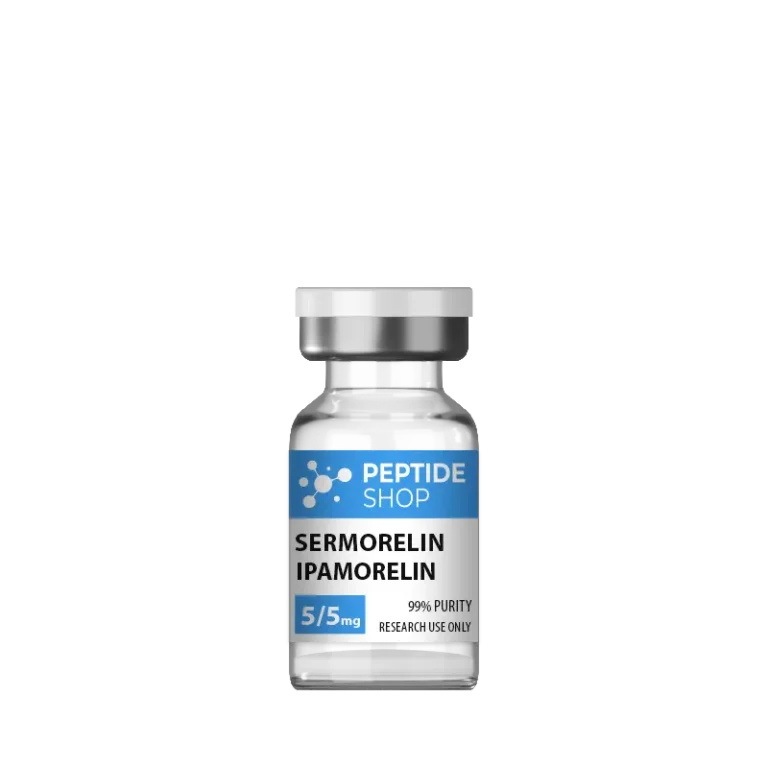
Researchers suggest that both CJC-1295 & Ipamorelin increase growth hormone (GH) levels by triggering the anterior pituitary gland. Based on clinical trials, scientists believe that once they have been triggered, growth hormones are naturally secreted, maintaining the GH levels in the body.
CJC-1295 is a growth hormone-releasing hormone that contains 30 amino acids that stimulate increased GH secretion and IGF-1 or insulin growth factor.
On the other hand, Ipamorelin is a beta cell stimulant hormone, which means it extracts hormones into the bloodstream and stimulates the pituitary gland to generate them.
Research and Clinical Studies
Half-life
Clinical studies have been conducted on test subjects to determine the half-life of these two peptides. Scientists have monitored the level of growth hormone after every administration of peptide. They noticed a single episode of growth hormone release at the highest peak at 0.67 hours, while later was an exponential decline. This study led scientists to conclude that Ipamorelin peptide has a short half-life of two hours after its potential action begins to decline.
When it comes to CJC-1295, it appears to have a much longer half-life. Researchers say that a single administration of the peptide can regulate growth hormone production for prolonged periods of time and contribute to the increase of GH secretion by 46%. Based on various research, it is believed that the half-life of this peptide can range between 5.8 and 8.1 days.
General Research
In the early 2000s, a clinical trial was conducted on test subjects, where one group received a placebo while the other CJC-1295 peptide. Doctors sampled the blood from both groups one week before and one week after to monitor growth hormone levels. At the end of the study, it was concluded that the group that received CJC-1295 increased the growth hormone levels 7.5-fold compared to placebo.
CJC-1295 and Ipamorelin are both growth hormone releasers, but they are different types. CJC-1295 functions by binding with the GHRH receptor on pituitary cells and causing conformational changes that trigger G-proteins to become active. This triggers the production of secondary messengers like cAMP and IP3, activating protein kinases. Protein kinases then stimulate phosphorylate transcription factors that can enter the nucleus and cause the expression of growth hormone-related genes.
When it comes to Ipamorelin, it is a GHS-R1a receptor agonist that interacts with the N-terminus of the receptor. The interaction is fleeting, triggered by van der Waals interactions and hydrogen bonding, resulting in conformational modification of the receptor. This stimulates the activation of Gαq/11 proteins, which activate phospholipase C (PLC). PLC hydrolyzes PIP2 into IP3 and DAG. IP3 initiates calcium release ions from the endoplasmic reticulum, while DAG activates protein kinase C (PKC). These signals ultimately result in the release of growth hormone from pituitary cells.
Nitrogen Balance
Based on the research conducted on test models, it appears that CJC-1295 and the Ipamorelin blend cause a positive nitrogen balance and potential increase in lean mass. The team of scientists evaluated the liver’s ability to produce CUNS or urea-N, a potential metric of nitrogen within the liver. They concluded that Ipamorelin might have caused a 20% decline in CUNS compared to the catabolic condition that the researchers artificially provoked.

Reviews
There are no reviews yet.