Description
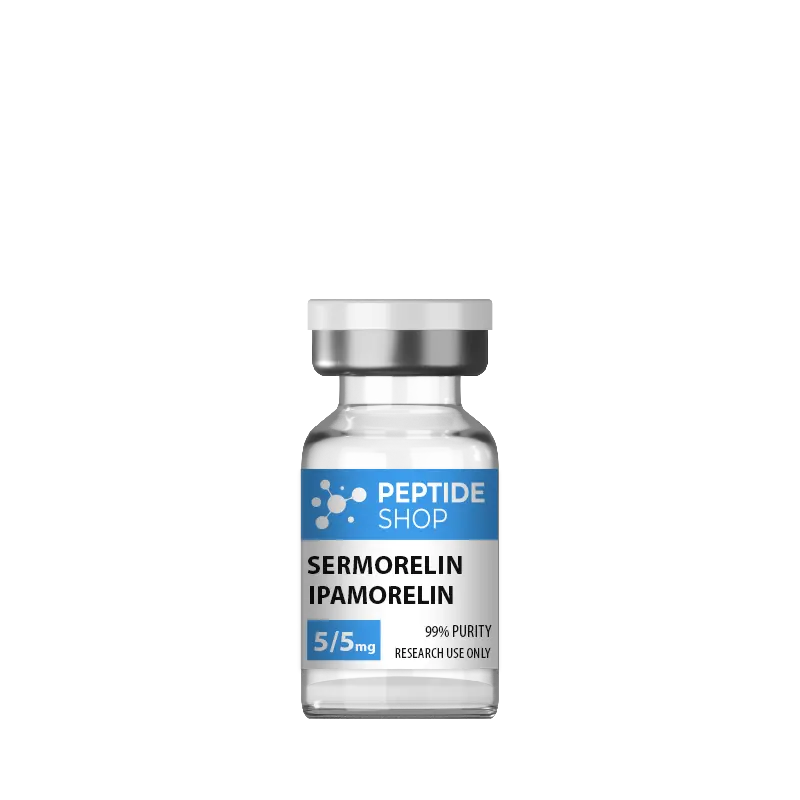
These two peptides are often combined because they have synergistic properties. Based on research conducted and application in laboratory settings, scientists have been able to prove that the Sermorelin Ipamorelin blend could slow down the aging process, decrease fat mass, enhance muscle mass, heal the gut, and reduce inflammation.
These two peptides mimic natural hormones within the body to stimulate the release of growth hormones from the pituitary gland.
Sermorelin, Ipamorelin Research
Sermorelin
This peptide is an analog of GHRH or growth hormone-releasing hormone, which stimulates the pituitary gland to release endogenous GH. By mimicking the first 29 amino acids of GHRH, Sermorelin is believed to retain the biological activity needed to activate GHRS or the growth hormone secretagogue receptor.
Researchers believe that this peptide might be particularly interesting in terms of how GH influences anabolic processes like metabolic regulation, cellular growth, and protein synthesis. Additionally, Sermorelin’s potential impact on the modulation of IGF-1, a mediator of growth hormone activity, has sparked the interest of the scientific community because of its regenerative implications and tissue differentiation.
Ipamorelin
Ipamorelin, however, is classified as a GHS or growth hormone secretagogue. Some studies have confirmed that Ipamorelin may bind to GHSR in the hypothalamus and pituitary. Compared to other growth hormone secretagogues, Ipamorelin is thought to be highly selective.
Scientists believe this peptide can trigger the release of GH without significantly altering other hormones like prolactin or cortisol. Therefore, this selective action implies that Ipamorelin could be a promising tool in tissue growth and energy homeostasis research.
The synergy of Sermorelin and Ipamorelin
Studies suggest that when combined, these two peptides may have a complementary impact, potentially enhancing GH release in a controlled manner. This led scientists to believe this peptide blend might be useful in research areas where selective and balanced GH stimulation is desirable.
Both peptides might target GH release via Ipamorelin through GHRS and Sermorelin through GHRH. This synergy between these two peptides may open new research opportunities, like regulating cellular longevity, tissue repair, and anabolic processes. Additionally, it has been speculated that the Sermorelin and Ipamorelin blend could offer unique insights into temporal patterns of growth hormone release, potentially offering new ways to study metabolic cycles, endocrine signaling, and circadian rhythms.
Regenerative studies
One of the more interesting areas for investigating this blend is regenerative science. Growth hormone is well-known for impacting cellular regeneration, mostly in connective and muscular tissue. It has been noted that the combined action of these peptides might support researchers in their idea to study cellular repair, tissue recovery, and regeneration when it comes to tissue degradation or injury.
Based on the research on animals, scientists believe that this blend might be relevant in investigating the repair mechanisms of cartilage, ligaments, tendons, and skeletal muscles, where growth hormone plays a significant role in promoting the proliferation of progenitor cells.
Endocrine and metabolic
Scientists believe that the Sermorelin and Ipamorelin blend may affect metabolic processes. Considering growth hormone regulates fat metabolism, glucose homeostasis, and metabolism, this peptide combination could be used to study metabolic conditions such as energy expenditure, fatty tissue differentiation, and insulin resistance in laboratory settings.
Summary
It has been speculated that this blend offers a unique framework for researching the complex psychological roles of GH and its broader implications in metabolic regulation, neuroendocrinology, and regenerative science.
By looking into distinctive ways which stimulate GH release, Sermorelin, and Ipamorelin may offer scientists a powerful tool for studying growth hormone dynamics in a controlled laboratory setting.

Reviews
There are no reviews yet.